
By Neil Shah, Founder & CEO, MusicAtlas · July 13, 2026
Every mature asset class has developed ways to evaluate opportunities before formal due diligence begins. Homebuyers look at a Zestimate long before commissioning an appraisal. Public market investors screen thousands of companies using market signals before reading a single filing. Venture firms evaluate hundreds of opportunities before asking for access to a data room.
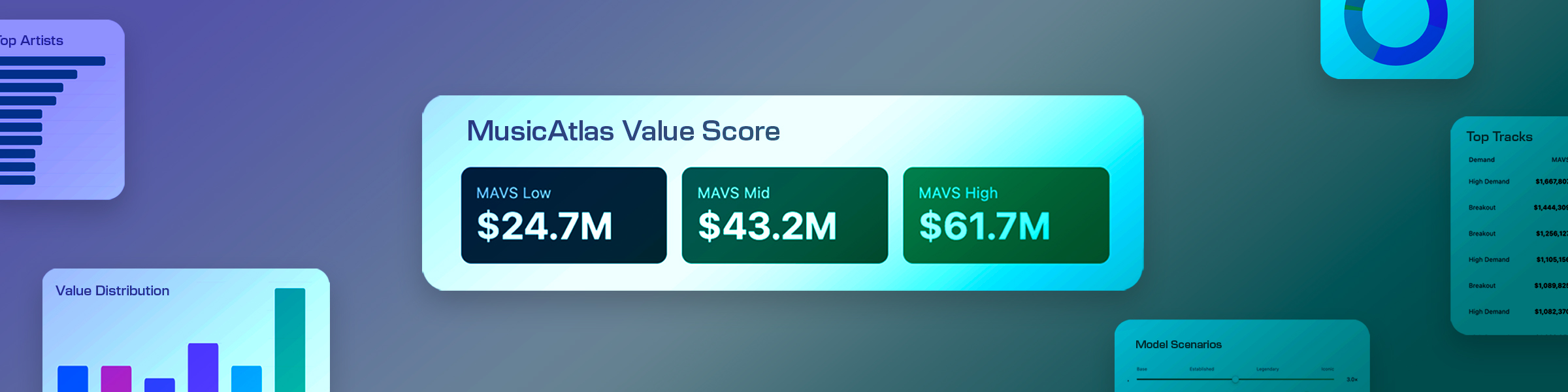
Traditional music catalog valuation begins with royalty statements. MusicAtlas Value Score begins with the music itself—combining thousands of first-party signals across sound, lyrics, chart performance, streaming behavior, cultural relevance, and millions of comparable recordings to generate an early investment signal.
MusicAtlas did not begin by building a valuation model. We built search infrastructure capable of understanding recorded music at scale. MusicAtlas Value Score emerged naturally once that intelligence reached sufficient depth and coverage.
For decades, music catalog valuation has begun only after financial information becomes available. Buyers collect royalty statements, publishing income, distribution reports, contractual information, historical growth, and other operating metrics before constructing a valuation model.
Those methodologies are essential. But they generally begin after both sides have already decided that a catalog is worth evaluating.
That leaves an important question unanswered: how should someone evaluate a music catalog before financial diligence begins?
Traditional catalog valuation asks a direct and important question: what is this catalog worth?
Answering that question properly requires a detailed understanding of financial performance, ownership, contracts, revenue concentration, historical growth, collection efficiency, recoupment, and risk. It is rigorous work, and it belongs at the center of any serious transaction.
But many investment decisions happen earlier. A buyer may be reviewing a prospective artist catalog before receiving royalty statements. A rights holder may want to understand the relative strength of different portions of a portfolio. A seller may want an initial sense of how the market could view a body of work before assembling years of financial documentation.
At that stage, the available information may consist of little more than a list of tracks. Historically, that list alone has offered very little analytical value.
MusicAtlas Value Score, or MAVS, was created to answer a different question from traditional valuation.
What is this catalog worth?
MusicAtlas Value Score asks:Is this a catalog worth spending more time evaluating?
Those questions may sound similar, but they belong to different stages of the investment process. One produces a transaction-ready valuation grounded in financial performance. The other produces an earlier investment signal that can help determine whether deeper analysis should begin.
MusicAtlas Value Score helps narrow the field before expensive diligence begins, allowing teams to reserve deeper analysis for the opportunities most likely to justify it.
MusicAtlas approaches catalog evaluation from the catalog itself.
We have built search and intelligence infrastructure capable of understanding recorded music across audio characteristics, lyrics, commercial performance, contextual relationships, catalog structure, and millions of interconnected data points. That infrastructure was originally designed to improve music search, discovery, licensing, and catalog operations.
As that system grew, we discovered that the same first-party intelligence could support a new kind of catalog analysis. Once enough is understood about the composition and context of a body of work, it becomes possible to generate a meaningful investment signal without beginning with private financial information.
That realization became MusicAtlas Value Score.
Rather than asking a user to begin with royalty statements, distribution exports, or revenue histories, MAVS begins with the simplest possible input: a list of tracks.
A catalog does not need to correspond to a company, label, publisher, or completed acquisition. It can be any defined group of recordings.
That makes it possible to evaluate an artist's complete body of work, a label roster, a publishing catalog, an existing portfolio, a prospective acquisition target, or a custom subset of tracks assembled for strategic analysis.
Existing music catalogs
Prospective acquisition targets
Individual artist catalogs
Label repertoires
Publishing catalogs
Portfolio segments
Custom groups of tracks
In other words, if a body of work can be expressed as a list of tracks, it can be evaluated with MusicAtlas Value Score.
The value of MusicAtlas Value Score is not that it adds another requirement to the acquisition process. It helps reduce the number of opportunities that need to enter expensive financial diligence in the first place.
Acquisition teams often encounter far more potentially interesting catalogs than they can evaluate deeply. Without an earlier signal, deciding which opportunities merit financial analysis may depend on limited information, reputation, familiarity, or the availability of a data room.
Broad set of catalog opportunities
↓
Request financial information
↓
Analyze multiple data rooms
↓
Build valuation models
↓
Identify the strongest candidates
Broad set of catalog opportunities
↓
Evaluate available track lists
↓
Prioritize the strongest signals
↓
Conduct diligence on fewer catalogs
↓
Build final valuation models
Financial diligence remains essential for any serious acquisition. MAVS makes that diligence more focused by helping teams decide where its cost and effort are most justified.
The result is a more efficient acquisition funnel: more opportunities can be screened, fewer need to proceed immediately into detailed analysis, and diligence resources can be concentrated on the catalogs with the strongest initial signals.
The closest familiar comparison may be Zillow's Zestimate.
A Zestimate gives buyers and sellers an immediate point of reference before a formal appraisal, inspection, title review, or transaction process begins. It does not resolve every question about a property, and it is not intended to. Its usefulness comes from changing the starting point.
Before automated real estate estimates became commonplace, evaluating a property required more friction and more specialized access. Zestimate made an early estimate available before the full process started.
MusicAtlas Value Score applies a similar idea to music catalogs. Both use observable characteristics and broader market intelligence to generate an early point of reference before complete private financial information is available.
The comparison is not that a music catalog and a home are valued in the same way. It is that both asset classes benefit from an accessible first signal before formal diligence begins.
Royalty-based valuation remains indispensable because financial performance ultimately matters. A serious buyer needs to understand where revenue comes from, how durable it may be, which rights are included, how concentrated the income is, what contractual restrictions exist, and how future cash flows should be modeled.
MusicAtlas Value Score does not compete with that work. It complements it by operating earlier and by starting from a different source of information.
Traditional valuation starts with revenue and works backward toward value. MAVS starts with the music and works outward toward an investment signal.
Used together, these approaches create a more efficient workflow. Catalog intelligence helps screen and prioritize a broad set of opportunities, while royalty analysis and financial diligence are concentrated on the smaller group that advances toward a transaction.
Catalog buyers face a screening problem before they face a valuation problem.
The universe of potentially interesting artists, catalogs, rights packages, and acquisition targets is much larger than the number of opportunities any team can diligence properly. The bottleneck is often not access to a financial model. It is deciding which opportunities deserve one.
An early investment signal can help acquisition teams compare more opportunities, identify unusual strength, evaluate artist catalogs before a formal process begins, and avoid committing equal diligence resources to every plausible target.
This can reduce unnecessary data requests and preliminary financial analysis while making proactive sourcing more practical. Instead of waiting for every opportunity to arrive with a complete data room, a buyer can begin forming a view from the catalog itself.
The same signal can be useful from the other side of the market.
Artists, labels, publishers, and catalog owners may want to understand how a body of work could be viewed before beginning a formal sale process. They may want to compare one segment of a portfolio with another, identify catalogs that merit deeper analysis, or develop a clearer view of where latent value may exist.
Because MAVS can be applied to any defined group of tracks, a rights holder is not limited to evaluating an entire company or portfolio at once. The same framework can be used to examine a specific artist, repertoire segment, genre cluster, acquisition package, or custom group of works.
This makes MusicAtlas Value Score useful not only for transactions, but also for strategic catalog management.
As music catalogs continue to mature as an institutional asset class, the ability to evaluate opportunities quickly will become increasingly important.
The market already has sophisticated tools for modeling revenue once financial data becomes available. What has been missing is a comparable intelligence layer built around the music itself.
That is the broader opportunity behind MusicAtlas Value Score.
Music catalogs are not only streams of historical cash flow. They are bodies of work with structure, relationships, market context, audience behavior, cultural position, and future potential. A stronger catalog intelligence layer can help make more of those characteristics visible before the financial process begins.
MusicAtlas Value Score is included as part of the SyncSearch catalog intelligence platform.
Once a catalog has been indexed, customers can generate investment signals, estimated valuation ranges, artist and track contribution analysis, and scenario modeling using the same intelligence that powers search, Catalog DNA, global performance tracking, and analytics.
Whether evaluating an existing portfolio or screening a prospective acquisition, MAVS works from the same catalog already powering everyday search and discovery.
→ Explore SyncSearch Catalog IntelligenceEvery acquisition begins with a decision about where to spend time.
Music catalog valuation will continue to depend on royalty statements, financial models, contractual review, and experienced judgment. None of that changes.
What can change is the starting point.
MusicAtlas Value Score introduces an investment signal before full diligence begins, giving buyers, sellers, and rights holders a way to evaluate any catalog from the music itself.
MusicAtlas Value Score was made possible by the search and catalog intelligence infrastructure MusicAtlas had already built. The same system designed to understand recorded music at scale can now help buyers, sellers, and rights holders evaluate the investment characteristics of a catalog before full financial diligence begins.
Traditional royalty-based methodologies and MAVS solve different but complementary problems. Financial analysis helps determine transaction value through historical performance and detailed diligence. MAVS provides an earlier investment signal that helps identify which catalogs deserve that deeper work.
Because it begins with a list of tracks, MusicAtlas Value Score can be applied to existing portfolios, prospective acquisitions, artist catalogs, label repertoires, publishing catalogs, and custom groups of recordings: an investment signal for any catalog.
MusicAtlas Value Score, or MAVS, is an investment signal for music catalogs. It uses a list of tracks and MusicAtlas catalog intelligence to help buyers, sellers, investors, and rights holders evaluate a catalog before full financial diligence begins.
No. MusicAtlas Value Score can be generated from a list of tracks without requiring royalty statements, distribution exports, revenue histories, or an existing financial model.
No. MusicAtlas Value Score occupies an earlier stage in the investment process. It complements royalty-based valuation and full financial diligence by helping users determine which opportunities may deserve deeper analysis.
Both provide an early point of reference using observable characteristics before complete private financial information is available. A Zestimate does not replace a real estate appraisal, and MusicAtlas Value Score does not replace full catalog valuation or due diligence.
Yes. MusicAtlas Value Score can be applied to prospective acquisition targets using a list of tracks, even before royalty statements or detailed financial data are available.
MusicAtlas Value Score can be applied to any defined group of tracks, including artist catalogs, label repertoires, publishing catalogs, existing portfolios, prospective acquisitions, and custom subsets of recordings.